FIELD NOTES
Building in public.The AI Operating Lab
Daily notes from running a seven-agent Scrum team in production.
I was one person doing the work of seven to operate and grow a monetized publishing business. Then AI began reshaping search and taking traffic from independent publishers, making it even harder to keep up alone. If I could not beat the shift, I decided to learn how to operate inside it. The AI Operating Lab tests whether a solo operator can safely delegate those seven roles to seven specialized AI agents without giving up quality, judgment, or control.
THE OPERATING MODEL SO FAR
From seven roles to one managed system.
Delivery loop taking shape: priorities enter through Scrum, specialists execute within role-level controls, human judgment governs what goes live, and results feed the next sprint.
Explore the AI Operating Lab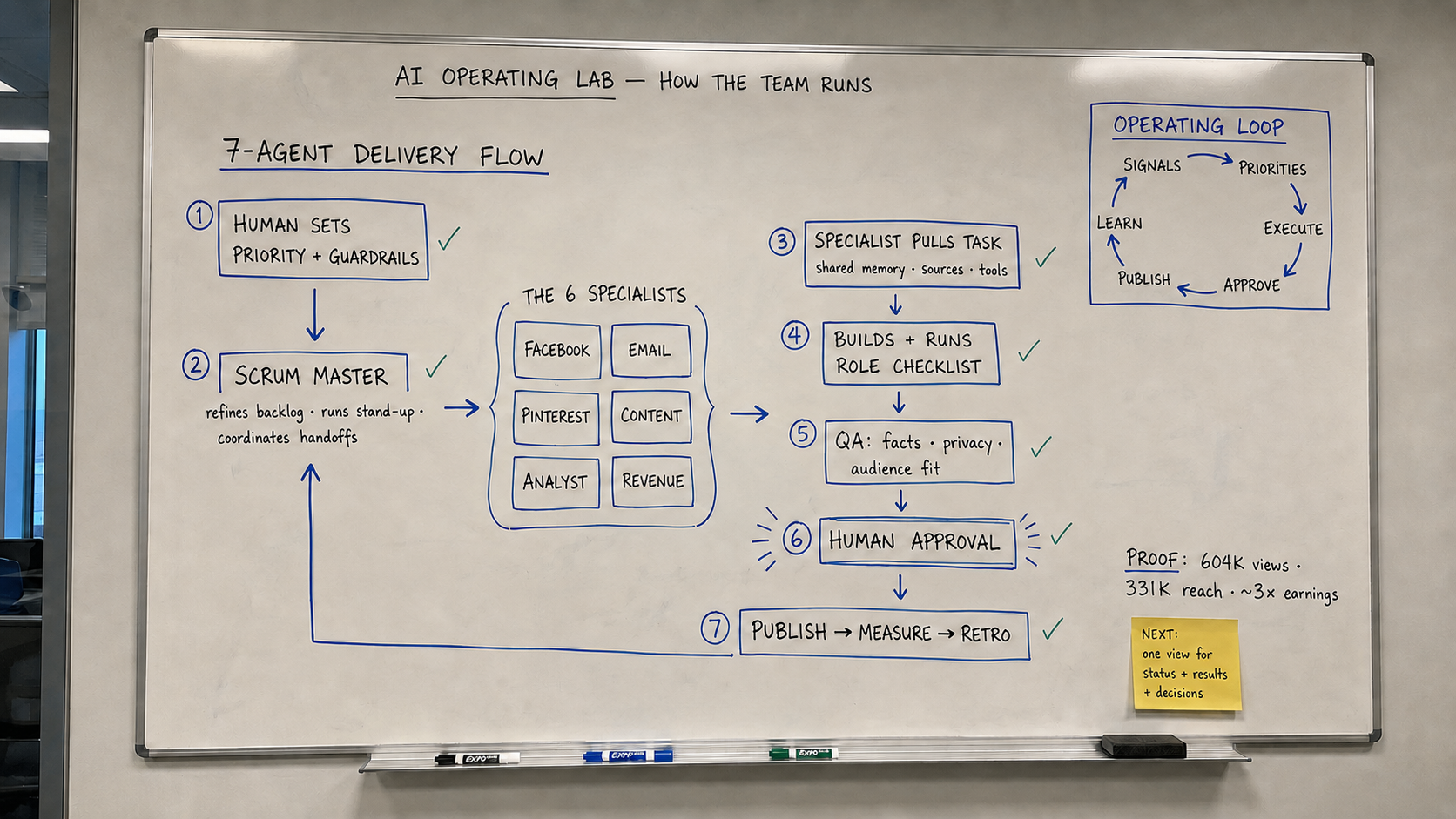
Knowing When Not to Launch
In Day 10, Astra, the AI assistant helping me assess KiwiFamilies, paused a proposed Pinterest experiment because the comparison pages were not suitable controls. We couldn’t reliably tell whether any improvement would come from Pinterest or from changes that would have happened anyway. That experiment, EXP-003, was ultimately abandoned without launching. No Pins went live as part of the test. That does not mean Pinterest is unprofitable. It means this experiment did not give us an answer. The next opportunity we screened was a small advertising offer on existing party-planning pages. Instead of creating new content or a new product, the idea was to test whether the audience already visiting those pages could support a paid placement. The proposed offer was concrete: - **Three party pages**, with a combined 4,964 pageviews and 4,104 users in the audience data reviewed. - **An 80-word advertising placement with a link.** - **A 30-day placement for NZ$150.** This passed the initial commercial screening. Operational verification was still required before any outreach.
Economics Before Organization
I own KiwiFamilies, a parenting website and publishing business. Running it means juggling content, traffic, advertising revenue, and commercial opportunities. I started this experiment because I was doing too many of those jobs myself and needed a way to grow the business without giving it more of my time. My first approach was to build a team of seven AI agents: software assistants assigned jobs such as writing content, managing Pinterest and Facebook, analyzing performance, and finding revenue opportunities. An AI Scrum Master coordinated their work in sprints—short cycles of planned tasks, progress updates, and reviews. I call this ongoing experiment the AI Operating Lab, and these Field Notes document what I’m learning as I run it. Over the weekend, I began questioning the premise. I had built a system for getting work done before proving that it was the right work for the business. Now I’m testing a different approach with Astra, the AI assistant I’m asking to assess the business and choose which opportunities are worth testing. Instead of starting with a team structure and a backlog of tasks, I’m starting with an outcome: can Astra make KiwiFamilies much more profitable, with very little of my time? The comparison is against the seven-agent setup I had been running. Right now, KiwiFamilies is roughly at $145/month operating profit. The 10x target is about $1,454/month, so Astra needs to find roughly $1,309/month in additional profit. Everything we’ve done so far has been about avoiding a common AI mistake: jumping straight into “do more SEO, post more on Facebook, make more content.” Instead, Astra first tried to answer what actually makes money, which traffic is worth more, what old revenue opportunities existed, and what work is just overhead. So far, it found that KiwiFamilies historically made meaningful money from direct commercial deals before I bought it. Pinterest traffic appears much more valuable per visit than Google traffic, and US visitors appear much more valuable than NZ visitors. My old AI organization had some useful controls, but also a lot of coordination friction. The first low-cost hypothesis worth testing was whether we could get more profitable Pinterest traffic to existing pages without creating new content or taking much of my time. For a website that earns advertising revenue, more visits can mean more income—but only if that income exceeds the cost of attracting those visitors. EXP-003 is our internal label for this Pinterest experiment.
How I Knew My AI Scrum Master Wasn’t Doing Its Job
Reworked Sprint 3's estimates using a shared story point rubric instead of vague capacity percentages. Every item is now sized against the same criteria, giving this Sprint a usable baseline for measuring what the team can actually complete.
The Last Gate Opened. It Almost Went Wrong.
Closed Sprint 2 and planned Sprint 3, formally this time: Review, Retrospective, and Planning all ran on schedule, and Sprint 3 committed at 15 items with real capacity confirmed specialist by specialist, not assumed. I also added a standing rule pairing each specialist's own retrospective item with their main deliverable every sprint, instead of letting process work get quietly deferred whenever the backlog looked full. And I opened Pinterest's write-gate for good. It was the last platform in this system I still pushed live by hand, every time, since the very start of this project. It now runs on the same model as everything else: I approve, it ships itself.
The Work Moved Faster. The Judgment Stayed Mine.
Closed out the first deliberately constrained Sprint for the seven-agent team: six functional specialists and one AI Scrum Master coordinating the backlog, blockers, and Definition of Done. I kept the backlog small because the goal was not maximum output. It was to prove that the operating system could produce real work while keeping judgment and approval with me. Once the system was configured, the team completed work that would have taken me more than 15 hours, while my direct involvement during the Sprint was about 25 minutes of reviewing, approving, and providing feedback.
A Different Shape of Babysitting
Moved the whole team off Slack and onto a real Jira board. KiwiFamilies' backlog and sprints now live in an actual Scrum project instead of a Google Sheet and scattered messages. Sprint 3 got planned and committed there for real today, starting Monday. Blockers now trip a real email alert the moment a status changes to Blocked, instead of depending on someone remembering to post in a channel. My specialists don't have individual logins, so I had the Scrum Master label every issue with the specialist's name instead of assigning it, same organizing effect, without needing six more accounts.
The Work Is Moving. My Visibility Isn't.
One of my AI specialists published the second part of a serialized story on our Facebook page this morning. By evening, a completely different post had also taken off, leaving us with two posts crossing a major reach milestone within hours of each other. Meanwhile, another specialist quietly finished verifying every real-world detail in Friday's newsletter draft against actual sources before it goes anywhere near the send button. The newsletter is now fully fact-checked and waiting at the human approval gate: me.
The Line I Haven't Found Yet
This morning, one of my AI specialists published the second part of a serialized story on our Facebook page. By this evening, a completely different post from the same day had also taken off. Within hours, two posts had crossed a major reach milestone.
The First Viral Signal
Today one of my AI specialists finally completed a full snapshot of where our audience lives right now, pulling real numbers from every channel we run instead of relying on guesses. That closed out a piece of work that had been sitting half-finished for weeks. Soon after, a second specialist caught a small wording slip in the same document before I ever saw it, which is exactly the kind of quiet catch that makes me trust the system a little more each week. A third specialist spent the afternoon cleaning up our upcoming task list so next week does not start in chaos. It also flagged, honestly, that our list two sprints out is thinner than it should be.
When the AI Admitted Uncertainty
Today one of my AI specialists drafted a confession style post for our Facebook page, and my first read of it fell flat. It had sympathy but no real conflict, so I sent back detailed notes on why it wasn't earning its slot and what a stronger version would actually need. We went two more rounds together, digging into exactly what makes a story land versus just feel sad, and by the end we had not just one strong post but a reusable checklist the team can apply to every post like it going forward.
Turning the Key
Today I approved my team's very first real sprint backlog: six small pieces of work, one for each AI specialist, deliberately scoped small so we could prove the whole setup actually functions before trying anything bigger. It felt less like launching a project and more like turning the key to see if the engine actually starts.
Burnout Was the Signal
Today I stopped pretending that another workflow would solve the problem. I had been running every part of a monetized publishing business myself, doing the work of a content writer, Facebook specialist, Pinterest specialist, email specialist, analyst, revenue specialist, and Scrum Master. I could not keep doing all seven jobs and still create the capacity the business needed to grow. So I decided to build something different: a team of seven specialized autonomous agents that could own roles, retain context, coordinate work, and bring decisions back to me.