Managed agent team
A Scrum Master coordinates six channel and business specialists through shared priorities, context, and operating rules.
AI OPERATING LAB · KiwiFamilies.co.nz
Liz uses KiwiFamilies.co.nz to test AI ideas under real operating conditions, develop safe practices, and prove measurable business value.
The business need
Liz needed a way to increase content output, audience growth, and marketing capacity as a sole operator. The goal was not automation for its own sake. It was a safe system that could operate, learn, and create measurable value.
The operating model
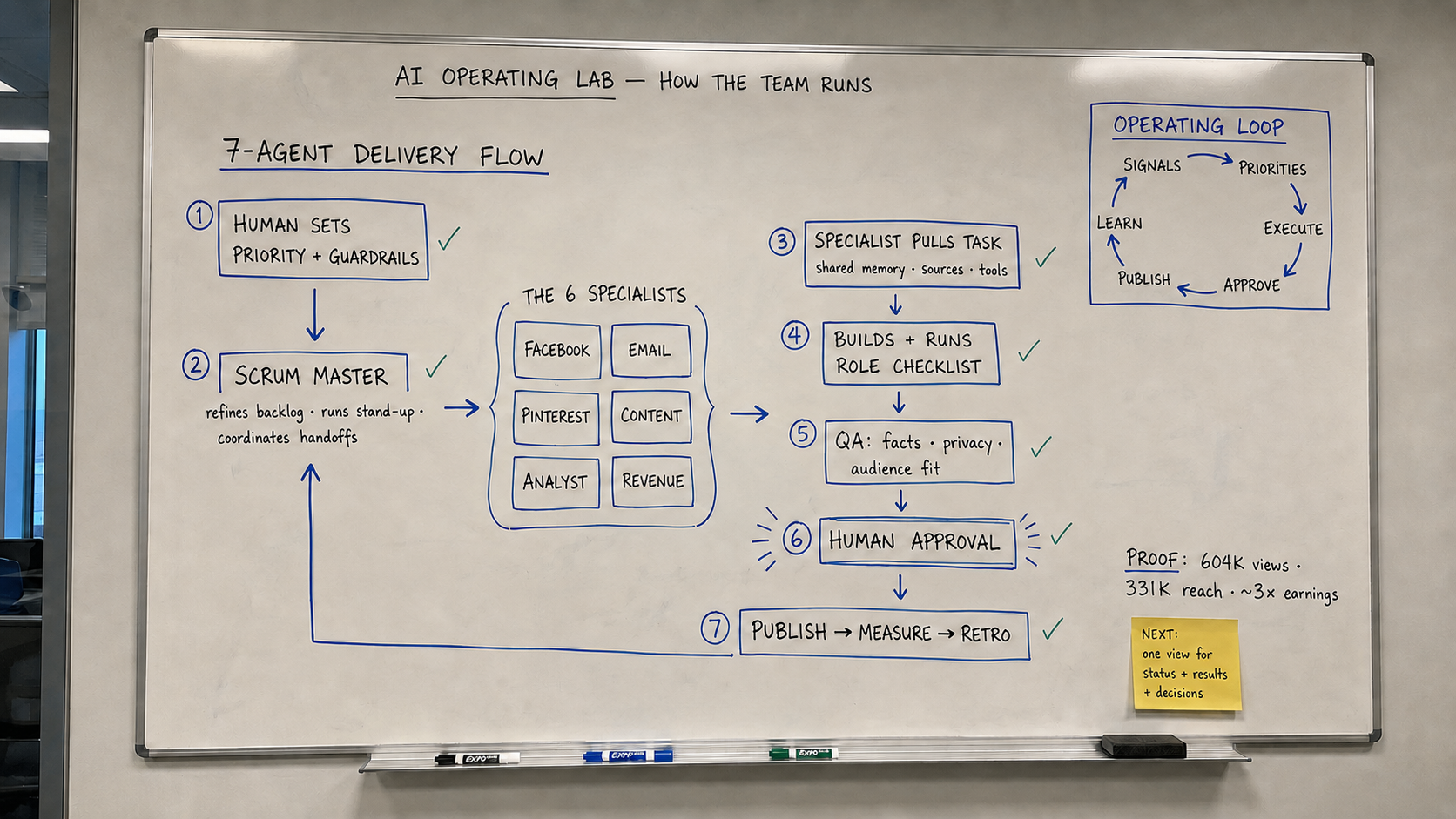
The Scrum Master coordinates priorities. Specialists produce channel-specific work. The analyst measures results, and Liz reviews and approves external action.
How the team runs
Operating evidence
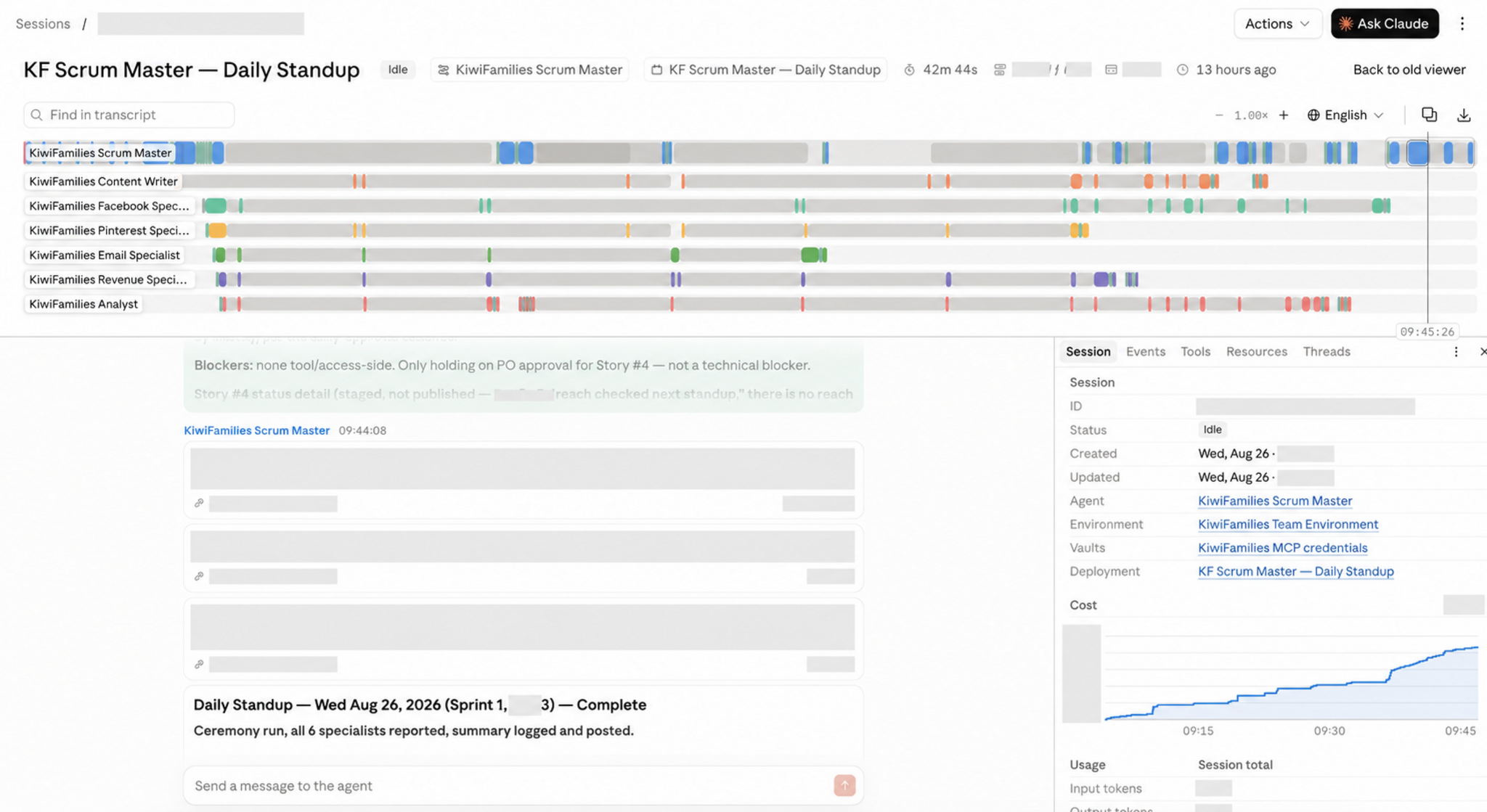
The system
A Scrum Master coordinates six channel and business specialists through shared priorities, context, and operating rules.
Specialized agents support content planning and production while Liz retains review and publishing accountability.
A custom workflow handles content calendar generation, AI image and copy production, plus manual and API publishing.
Protected actions stop for review so speed never removes accountability from external or irreversible decisions.
Governance by design
The hardest problem
Reliability came from the operating system around the models, not from trusting a single response. Roles, context, ceremonies, controls, and performance data reinforced one another.
The outcome
Article production decreased from more than eight hours to under two hours.
The Pinterest workflow reached 240 approved posts per month.
Traffic reached 69K peak monthly pageviews and 2.5x growth, with zero content-safety failures.
Leadership lesson
“AI needs an operating system, not isolated tools.”
Coordinated roles, shared memory, Scrum routines, analytics, governance, and explicit human accountability turn generative AI capabilities into a system that can create dependable business value.
Explore the work